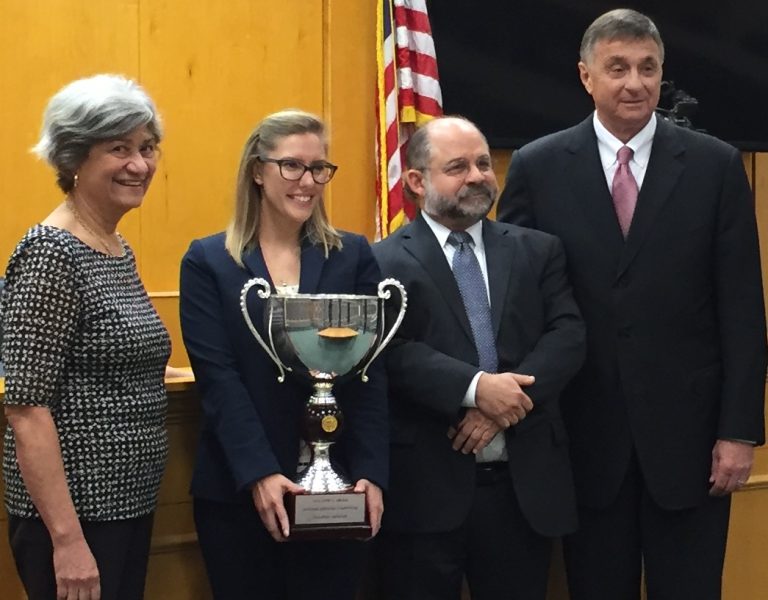

South Texas College of Law Houston was chosen to receive the Texas Access to Justice Commission’s (TAJC) 2025 Law School Commitment to Service Award — marking the fifth time the law school has received it since the recognition began in 2008.
South Texas Law was recognized by the Supreme Court of Texas at a presentation Nov. 3 at the Bass Concert Hall in Austin during the New Lawyer Induction Ceremony.
Catherine Greene Burnett, associate dean for experiential education and professor of law, said, “This award helps remind us there is always a need for dedicated public service. That work is never truly done. And that work is never done alone. Today’s award represents the collective work, passion, and support of so many members of our community — staff, faculty, and students.
The Commitment to Service Award recognizes a law school that has “distinguished itself by carrying forward one of the finest traditions of the legal profession by actively educating its students about access to justice issues,” noted the recognition letter from Harriet E. Miers, TAJC chair, and the Hon. Latosha Lewis Payne, chair of the awards committee and presiding judge of the 55th Civil District Court in Harris County. “South Texas College of Law Houston’s commitment to teaching its students how they can help address the dire needs of the poor in Texas is indeed commendable.”

Serving the Greater Houston community through free legal services for underserved individuals and families is a key part of the mission of South Texas Law, and law students play a central role. The law school’s mission is to provide a diverse body of students with the opportunity to obtain an exceptional legal education, preparing graduates to serve their community and the profession with distinction. South Texas Law takes the “service” part of its mission very seriously; pro bono service is a South Texas tradition.
Carlos A. V. Calderón, JD, senior director of legal services for the clinics, said, “We want to help as many people with legal services as we can while giving students the opportunity for real-world client engagement. ”
Much of the pro bono service at the law school occurs through the Randall O. Sorrels Legal Clinics, which have been serving low-income individuals in the region with free legal services for more than three decades. This past academic year, 172 students served real-world clients with free legal services, supervised by licensed attorneys in the clinics. The legal professionals who teach in the clinics guide and mentor these students — who provide thousands of hours of pro bono service each academic year.
Last year, the clinic staff closed 711 cases, with participation by the students, affecting approximately 2,000 people. The clinics also wrapped up a grant-funded pro bono project that helped thousands of families avoid wrongful eviction and stay in their homes.
The clinics provide students with opportunities to interview, counsel, and advise clients who are part of the Houston area’s underserved population. Students gain valuable experience working alongside seasoned attorneys across roughly 20 practice areas. In a typical year, students in these clinics provide more than 35,000 hours of direct client services valued at roughly $2 million, mediate more than 150 disputes, and file more than 40 trademark applications.
Burnett affirmed that South Texas Law is committed to practice-ready education, and students learn early that serving low-income Texans through the clinics is one of the most rewarding experiences in which to participate at the law school. More than 300 students annually participate in clinics and externships because they want to help people — and to learn “how to lawyer.”
This TAJC award is presented annually to an accredited law school in Texas (there are 10) that encourages students to engage in pro bono service. The letter to South Texas Law from Miers and Payne concluded, “Congratulations, once again, on your efforts to improve the delivery of legal services to the poor.”