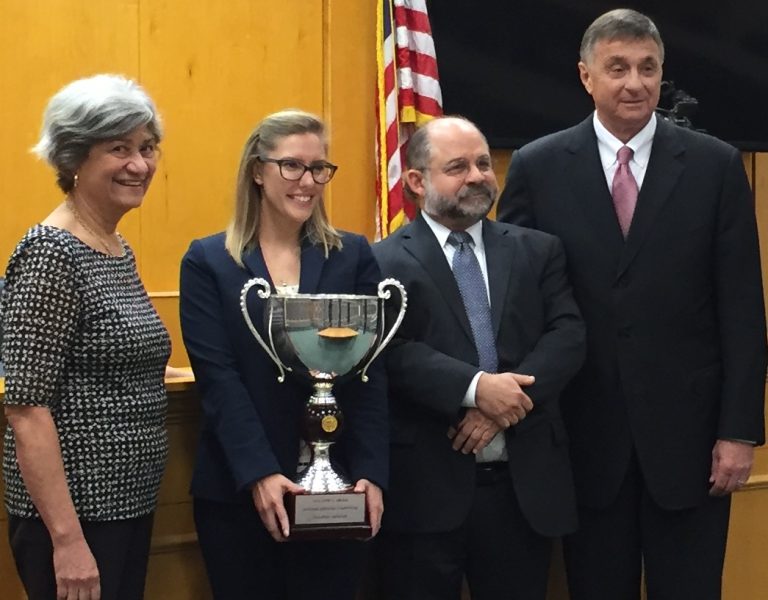

Four South Texas College of Law Houston students serving as 2025-26 Student Fellows in the Agosto Justice Center for Leadership and Empowerment presented thought-provoking research on relevant legal topics during an extended luncheon event in mid-April.
The Agosto Justice Center’s founding donor Benny Agosto, Jr., managing partner of Abraham, Watkins, Nichols, Agosto, Aziz & Stogner Houston, attended the event and engaged with each presenter after they spoke.
At the conclusion of the event, Agosto noted, “The brilliance of all of you fills my heart because that’s what I dreamed… that this center would be a think-tank,” he said. “I wanted students to come in and think about the law, think about good things, think about making the world a better place. I am so inspired, and my dream has come true.”
Assistant Dean of Leadership and Empowerment and Title IX Coordinator Donna Davis introduced the speakers and their topics. Here is a brief overview.
- Ali Ajani, “Limits of Executive Power: DACA” — Ajani is a second-year law student with bachelor’s and master’s degrees in economics from Texas A&M University. He has experience in both civil and criminal law through clerkships with a business litigation firm, state judges, and the Harris County Attorney’s Office. He is interested in pursuing criminal litigation to build courtroom experience before transitioning into civil litigation, particularly in business and personal injury matters. He seeks to build a career handling complex, high-stakes disputes. His paper on, “Limits of Executive Power: DACA and the Instability of Immigration Relief,” was published on SSRN (formerly the Social Science Research Network.)
Key points:
- Ajani noted, “The history of DACA … illustrates a deeper constitutional conflict between the limits of executive authority in immigration enforcement and the role of Congress in establishing long-term immigration pathways. This tension between the branches frames the legal debate surrounding DACA…and directly impacts the lives of hundreds of thousands.”
- “This paper demonstrates that reliance on executive discretion to implement large-scale immigration policy undermines the rule-of-law principle by creating inconsistent and unstable legal protections. It further examines how this instability produces real consequences for DACA recipients, particularly students and young professionals, whose access to education, employment, and professional licensing is contingent on a legally fragile program”.
- “Without congressional intervention to establish a permanent framework…the lives of DACA recipients will continue to be shaped by shifting presidential administration priorities and ongoing litigation.”
- Kea Bell, “Adequacy for Whom? Education, Equity, and the Fourteenth Amendment” — Bell has nearly seven years experience supporting attorneys across multiple practice areas. She earned her bachelor’s degree in business administration (BBA) from the University of Louisiana at Lafayette. In Bell’s fellowship research, she examined educational adequacy and practical frameworks for ADA accommodations and neurodiversity-related discrimination. She is a newly inducted Albert Schweitzer Fellow, advancing a health-literacy and transparency initiative to support underserved Texans navigating complex healthcare systems. Across her projects, Bell has focused on expanding access to clear, culturally grounded information and empowering communities to understand and exercise their rights.
Key points:
- Bell described how the 14th Amendment is meant to prohibit states from depriving people of “liberty,” and she connected how gaining education has long been linked to liberty — to freedom. In San Antonio vs. Rodriguez, challenging Texas’s inequitable education system, the U.S. Supreme Court ruled that education is not a “fundamental right.”
- Bell argued that education is necessary for democracy and improves an individual’s years of and quality of life. She described many ways education has become more equal over the decades — but not more equitable.
- “Everyone should have a right to education based on the 14th amendment,” Bell said. “Now it’s time to move from marginalization to competitive participation in a global society, and from equality to equity.”
- Junior Gallo, “The Illusion of the Fourth Amendment: ICE and the Erosion of Constitutional Rights” — Gallo, a third-year law student, earned his BBA in management information systems from Texas Southern University. Born in Benin City, Nigeria, and raised in Houston’s multicultural community, his journey to U.S. citizenship shapes his passion for examining the legal boundaries of immigration enforcement. Gallo’s research focused on constitutional protections, particularly the Fourth Amendment, and the ways in which those protections are applied to noncitizens. After graduation he focus on his bar studies and become a complex litigation associate this fall.
Key points:
- The Fourth Amendment protects individuals against unreasonable searches and seizures by the government. Gallo’s thesis asked this question: “To what extent have ICE practices eroded Fourth Amendment protections by routinely exceeding constitutional limits on searches and seizures, and how does this shift reflect growing division between constitutional parameters and government enforcement?
- Gallo described a number of serious injuries and deaths that have occurred in ICE arrest situations and situations where administrative warrants allowed ICE overreach.
- He recommended some immediate changes to ICE: 1) require judicial warrants for home entry; mandate clear, written standards for searches; and strengthen training on constitutional limits and lawful search procedures.
- Bijaar Ishaq, “The Great Replacement and the First Amendment: Hate Crimes, Terrorism, and the Limits of Liability” — Ishaq is a second-year law student who is originally from Balochistan, Pakistan. He earned his undergraduate degree from the University of London. He is an oral advocate and brief writer for the South Texas Law Advocacy Program and a member of the South Texas Law Review. He also is vice president of the Muslim Legal Society and South Asian Law Students Association at South Texas Law.
Key points:
- Ishaq described the Great Replacement Theory (GRT) — a conspiracy theory that non-white cultures are trying to replace the white population, white culture, and white power in Western nations — an idea more recently pushed by French writer Renaud Camus.
- Ishaq explained how GRT has been demonstrably tied to mass violence, often starting with dangerous rhetoric and threats, but noted that the U.S. First Amendment has generally prevented actions to punish people for the inciting rhetoric — only allowing actions after violence has occurred.
- He raised awareness that the U.S. does not have a general “hate speech” exception to the free speech protected by the First Amendment, and even “serious expressions of intent to commit violence against a person or group” are often disregarded as a substantial risk and provide limited liability.
Davis shared an overview about the Agosto Student Fellows Program. “Participants in the Student Fellows program gain knowledge and skills in the focus areas of justice, access, leadership and empowerment (JALE),” Davis said. “In addition to conducting critical research on JALE topics, the fellows:
- Collaborate and network within the law school and through external legal communities;
- Contribute to the cultural, academic, and professional student experience;
- Participate in programs through the center that enhance their leadership skills;
- Serve as liaisons between the center and other campus organizations; and
- Assist in building a welcoming community focused on inclusivity and creating a sense of belonging for current and prospective law students.