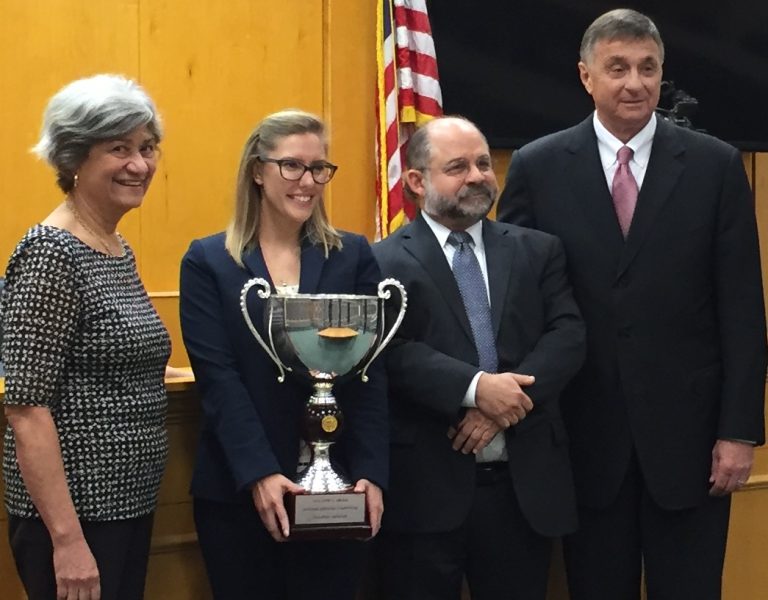

Eleven South Texas College of Law Houston alumni and the law school’s President and Dean Rey Valencia recently shared the distinctive experience of being admitted to practice before the Supreme Court of the United States (SCOTUS) in Washington, D.C.
Those admitted to practice during the prestigious swearing-in ceremony were Daniel B. Armentor ’22, Randall L. Beaty ’16, Alan D. Borden ’08, Hayley D. Harrison ’17, Kevin D. Hunter ’14, Maria Virginia Ivanez ’16, Jose S. Lopez ’03, Lisa A. Louck ’91, Jennifer E. Peltier ’21, Marca Ewers-Shurtleff ’14, Reynaldo Valencia, and Michael C. Watson ’99.
Ewers-Shurtleff felt particularly drawn to this opportunity. As a law student, she had studied comparative criminal justice under Supreme Court Chief Justice John Roberts while attending South Texas Law’s Study Abroad Program in Prague.
“That experience remains a highlight of my academic, professional, and personal life experiences,” Ewers-Shurtleff said. “When the opportunity arose to obtain admission to the Supreme Court Bar, I couldn’t sign up quickly enough!”
The trip, organized by the South Texas Law Office of Advancement and Alumni Engagement, included a private breakfast prior to the event for the attorneys being admitted and their guests. Accompanying the group was Josh Blackman, South Texas Law’s Centennial Professor of Constitutional Law, who had the honor of making the motion to admit them.
“It was a special day for me,” Blackman said. “For the first time, I moved for admissions at the Supreme Court.” Five of the lawyers seeking admission to practice before the nation’s highest court were Blackman’s former students.
Admittance to the U.S. Supreme Court Bar is a lifetime membership that authorizes lawyers to argue cases before the court, submit amicus briefs, and receive a formal certificate of admission. In addition to the swearing-in ceremony, participants receive preferred seating for oral arguments, access to the Supreme Court’s library, and recognition as a member of the highest court’s Bar.
Those being sworn in from South Texas Law were recognized by name in open court by the justices. They took the Supreme Court Admission Oath: “I, [Name], do solemnly swear (or affirm) that as an attorney and as a counselor of this court I will conduct myself uprightly and according to the law, and that I will support the Constitution of the United States.”
Blackman, one of three movants on the docket that day (the individuals who put attorneys forward for admittance to the Supreme Court Bar), enjoyed the process and the experience.
“All the staff from the clerk’s office were extremely professional and organized,” Blackman said. “Everything was executed to perfection.”
Blackman, an experienced legal professional admitted to practice before the court in 2016, has seen multiple bar admissions and attended many arguments before the Supreme Court. He felt this experience — of actually being on the docket himself — was very different.
“I was a bit nervous when the clerk called my name,” Blackman said. “Actually making a motion before the Supreme Court is a serious affair. And, as has often been remarked, the Justices are very, very close. Some of them are looking down at papers. Others are looking into the distance. But the Chief Justice looks right at you.”
Reading from a script he had prepared, Blackman began: “Mr. Chief Justice and may it please the court, I move the admission of the following attorneys.” Then he read the attorneys’ names and concluded with “I am satisfied each possesses the necessary qualifications.”
Blackman said, “I took a breath, and braced myself for, ‘we will take the matter under advisement,’ but the Chief Justice said, ‘your motion is granted.’ I sat down. The clerk then issued the oath. The Court shifted to oral arguments. I could relax.”
Shurtleff said, “This entire experience — from entering the SCOTUS courtroom, to taking the oath, to hearing SCOTUS opinions live and witnessing oral arguments — will have a resounding effect on the way I practice law. It is no surprise to any attorney that the practice of law, by its very nature, subjects its practitioners to immeasurable amounts of stress, pressure, client expectations (both unreasonable and reasonable), and a myriad of challenges. However, entering the hallowed halls of the SCOTUS and directly witnessing the pinnacle of the justice system in action provided me a refreshing and energizing reminder of why many of us were called to this profession.”