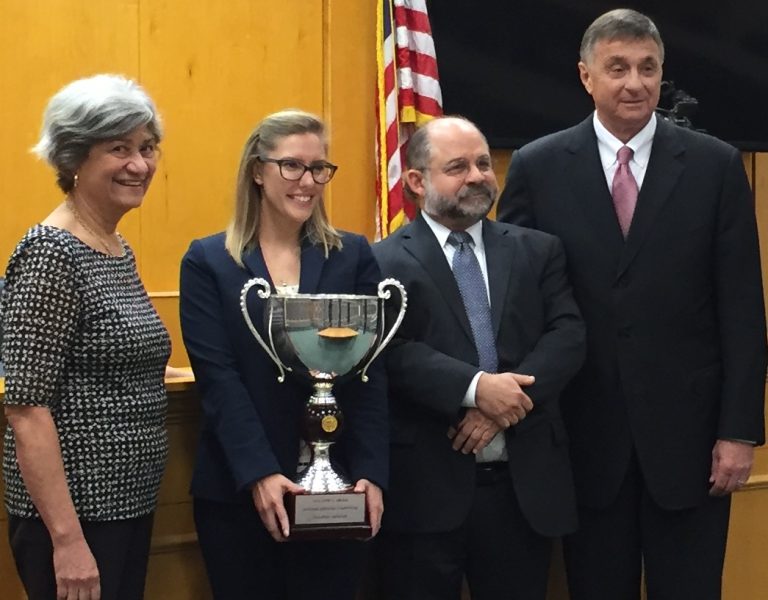

Alumna Sharon Schweitzer ’89 — South Texas College of Law Houston board member, board of visitors member, and adjunct professor — provided cultural competency training recently for students and faculty who will be traveling to Prague, Czech Republic, this summer with the Study Abroad program.
Schweitzer, an internationally recognized expert on global mobility, cross-cultural communication, and international protocol, often provides this type of training to global companies, law firms, and organizations.
She will travel with South Texas Law’s Study Abroad group once again (she joined them last year) and continue her training as students experience a new country with different cultural norms than the United States.
“Our personal cultural values run really deep,” Schweitzer said. “Self-awareness is important as you engage with other cultures. Who are you and what is your background? What cultural values drive you in ways you may not recognize? It’s hard to understand another culture if you don’t understand yourself first.”
To help students understand some of the cultural values that might impact them now in law school and later as attorneys, Schweitzer had students self-identify as risk takers or individuals who are risk averse and as planners versus spontaneous individuals.
“If you are a big risk taker negotiating a class project or a contract with a very low risk-taker, you may be dealing with push back you don’t understand,” she said. “The low risk-taker will likely be very prepared, want more information, need all questions answered, and have little doubt of success before agreeing to move forward. If you are a high risk-taker, you may be much more willing to move ahead while the situation is more fluid and without all the answers. To succeed, you have to find a way to see the other person’s perspective, and adjust, so you can find a solution together.”
To put this in the context of global travel, Schweitzer noted that — in general — people in the Czech Republic tend to be less willing to take risks that people in the U.S., and the Czech culture tends toward long-term planning versus short-term answers and spontaneous solutions.
Schweitzer, who is half Czech, said she can see these differences in observing her family members who live in the Czech Republic. She also cautions that talking about cultural values of a country means offering national generalizations, which may not be true for every individual.
“More than likely, if you are from the U.S. and meeting with someone in Prague for what you consider a brainstorming session, you will find they arrive early with research, a plan, assignments, and strategies to which they want to firmly adhere… and you may arrive with some general ideas you planned to flesh out through an open discussion,” Schweitzer said. “People who have low risk tolerance and who have a long-term planning perspective rarely come unprepared and may not be willing to change their minds or commit to a new plan with many unknowns — even if it potentially offers greater success.”
Uncertainty avoidance (level of comfort with ambiguity and change) and long-term orientation (future planning vs. tradition focus) are just two of social psychologist Geert Hofstede’s six cultural dimensions Schweitzer discusses in her training. The others are power distance (acceptance of hierarchical inequality), individualism (self-reliance vs. group loyalty), indulgence (freedom vs. social restraint), and masculinity (which Hofstede later said is misnamed but means achievement vs. cooperation values).
“Going into social and educational interactions in Prague, we need to recognize that U.S. Americans — in general — tend to feel freer with less social restraint, to be more individualistic, to ignore hierarchy, to be comfortable with ambiguity, to take greater risks, and to be more focused on the here and now versus the longer term,” Schweitzer said. “Of course, as you can see from our exercise today, while generalizations may give you context, you need to build relationships and get to know the individuals with whom you are studying, negotiating, or traveling. Our personalities may be quite different than our national, cultural norms.”
Schweitzer also noted that the cultural dimensions described by Fons Trompenaars and Edward Hall will be addressed during the on-site training in Prague.
At the recent training session on campus, professors Claire Andresen, Matt Festa, and Telia Mary Williams provided insights for the students about the classes they will teach in Prague. Also, three former Study Abroad participants — Kelly Torpy, Kristina Gantz, and Elvia Sanchez — gave students helpful tips on housing, transportation, travel, and more.
Prof. Lewinbuk, director of international programs at South Texas Law, gave the students important information about the upcoming trip, scheduled May 22-June 19, and the about the value of the cultural insights shared by Schweitzer.
Lewinbuk noted, “In my own experience teaching, learning, and traveling, I have been tremendously enriched by Sharon’s involvement in our programs… by her expertise, her dedication to our students, and the great time commitment she makes to continue enhancing South Texas Law and our international programs. We are so grateful to her.”