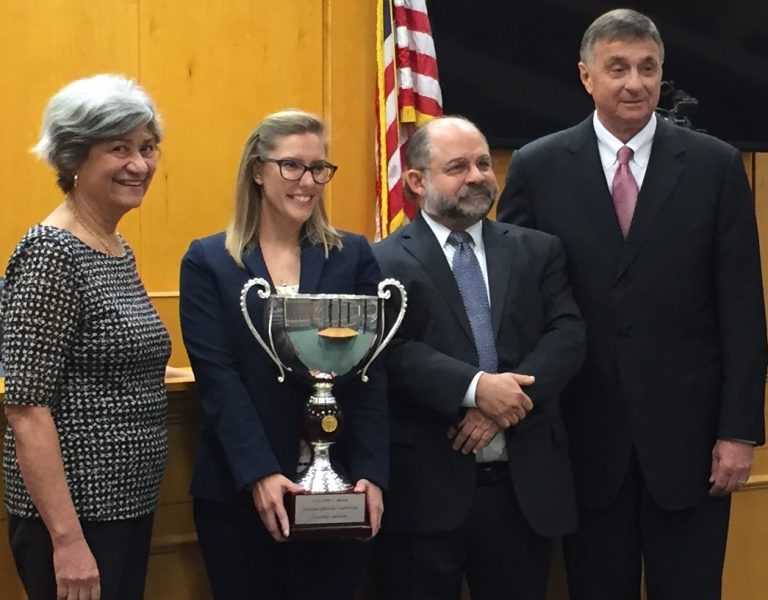

Students from South Texas College of Law Houston served in judicial externships at every level of court in the summer, and they had public interest and corporate internships that stretched from Washington, D.C., to Montana, Louisiana, Tennessee, and Florida.
Closer to home, a group of students spent the summer at the Harris County District Attorney’s Office, working with prosecutors on cases that will shape the lives of victims, defendants, and families across the region.
According to Aimee Maldonado, director of academic externships and adjunct professor, STCL Houston students regularly intern and get hired in the DA’s office because of their interest in becoming prosecutors. She said South Texas Law has sent a steady stream of students and alumni to that county office through the years.
“The interns earn academic credit while building courtroom-ready skills, long before they sit for the bar exam,” Maldonado said. “Often, they do such as impressive job as interns that they are hired quickly after law school to join the staff full time.”
Learning to Build a Case
Clarissa Vasquez, who expects to graduate in May 2027, spent her summer as an academic intern in the Domestic Violence Bureau, working primarily for Felony Chief Maegan Williams and several felony assistant district attorneys. Her work included reviewing defendants’ recorded jail calls for material attorneys could use at trial, assisting with jury selection, researching case law for pretrial motions, drafting witness and exhibit lists, and taking trial notes for prosecutors.
“I do feel like I was prepared for most of these tasks, especially after taking Evidence with Professor Breland,” Vasquez said. She noted that the internship gave her a start-to-finish view of how a case comes together. She hopes to work at a district attorney’s office after graduation.
Gabriella Gregorski, who will begin her 2L year this fall, interned in a misdemeanor court for Deputy Chief John Hyde. Her responsibilities included screening incoming cases — summarizing police reports, noting the elements of each charge, and reviewing defendants’ criminal histories — and assigning tasks to gather evidence. She also made condolence calls to crime victims’ families and observed court dockets, hearings, pleas, and trials.
“I think this experience greatly impacted my law school experience because it granted me the opportunity to observe the daily activities of prosecutors,” Gregorski said. She hopes to become a prosecutor herself one day.
Jeffery Wu, class of 2027, worked in a different corner of the office: post-conviction and parole-related matters, with Amber Joachim, Chief of the Parole Protest Division and Fugitive Apprehension Division. His tasks included drafting parole protest letters, reviewing case files, sending detainer-related emails, preparing writs, and researching specific rules.
“Law school gave me a solid foundation in reading, writing, and research,” Wu said. “But I also learned from work that real-life cases often have much more complicated facts than classroom assignments.”
Joshua Wood, a 3L, interned with the Vehicular Crimes Division under Chief Kayla Allen, reviewing body camera footage, listening to jail calls, and researching and drafting memos.
“From doing these tasks I have been able to get a good glimpse about what prosecutors do each day,” Wood said. He also put his advocacy skills to the test in the office’s “intern closing argument” competition.
Advice from the Front Lines
Each student came away with lessons from the experienced prosecutors they worked alongside.
Vasquez said attorneys repeatedly urged her to watch as many trials, hearings, and jury selections as possible. “You will have a case you initially struggle with, but you will remember something an attorney did well in a different trial, and you can try to tailor that to your situation,” she said the attorneys told her.
Several assistant district attorneys advised Gregorski to build courtroom experience in law school through mock trial and moot court, noting that many of the prosecutors she worked with had done the same before joining the DA’s office.
Wu said the Chief of the Crimes Against Children Division told him that a prosecutor must be accurate and prepared. “Preparing questions, opening statements, and closing arguments can be very important to winning cases,” Wu said. “Prosecutors must pay attention to every detail and practice, because small details can affect the outcome of a case.”
The advice that stuck with Wood was more direct: be confident and be vocal. “Doing so will get you noticed and give you opportunities you will not have if you are passive and keep to yourself,” Wood said.
A Mission Worth the Long Hours
For Vasquez, the defining takeaway was the sense of shared purpose she found at the DA’s office. “Everyone here truly believes in the mission,” she said. “They all want this community to be a better place for everyone. And it is incredibly motivating to work in a place where everyone has the same goal.”
Gregorski said the fast pace of the office taught her the value of time management. “The DA’s office moves very fast, and each court has a large docket almost every day,” Gregorski said. “While it can be a taxing job at times, it’s very rewarding.”
Wu said his summer reinforced the importance of precision, down to the smallest details — names, dates, case numbers and procedural information. “Those details matter because prosecutors work on real cases that affect real people,” he said.
Watching victims’ families finally get answers left the biggest impression on Wood. “Some of these people wait years for justice to be done, and it is really special to see them finally get it,” Wood said.
Confirming a Career Path
For several students, the summer did more than build skills — it confirmed a career direction. Wu said the experience strengthened his resolve to pursue prosecution and public service after graduation, crediting the office’s internship coordinator with reminding interns that the job requires genuine passion for the work. Vasquez and Gregorski both said the summer solidified their goals of working as prosecutors after they graduate.
A Pipeline Built on Partnership
The students’ experiences this summer reflect a broader pattern: the law school’s Office for Academic Externships works year-round to connect students with placements like these — not just at the Harris County DA’s office, but in judicial chambers, public interest organizations, and corporate legal departments across Texas and around the country.
Students interested in gaining hands-on legal experience while earning academic credit are encouraged to email externships@stcl.edu or call 713-646-1763.