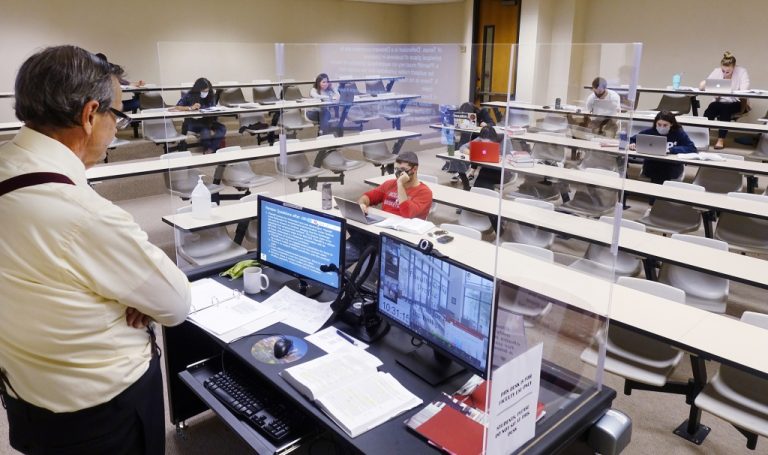
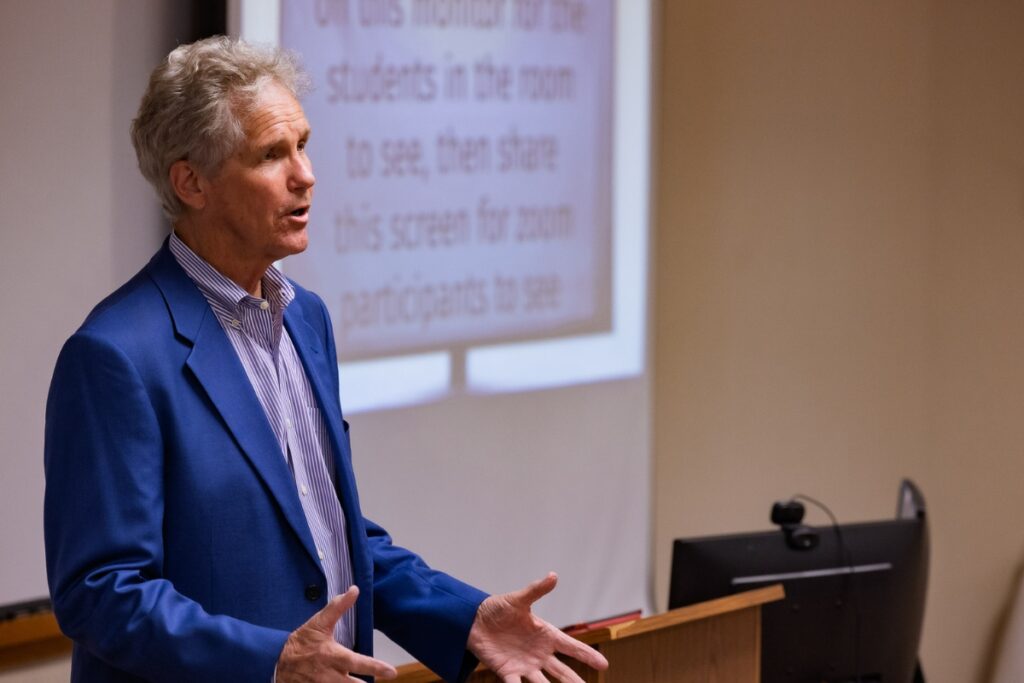
Adjunct professor Dan Downey is preparing to say goodbye to the classroom after more than three decades of teaching advocacy and entertainment law at South Texas College of Law Houston.
“Dan has been a fixture in the school for decades, teaching our students trial advocacy classes and entertainment law,” said Amanda Peters, STCL Houston associate dean of faculty and professor of law. “He has given his time, wisdom, and talents to our students. He also has passed on his beautiful suits to Law Suits to help our students in need of clothes for interviews and jobs. We are grateful for this dedication to the school and the students.”
Born and raised in Detroit, Downey earned his J.D. at Detroit College of Law in 1976. Like many of his South Texas Law students, he worked hard to put himself through law school, taking classes at night.
Downey began his legal career as a clerk for George Roumell, the distinguished attorney and former president of the Michigan Bar Association, who had been his labor law professor. “He taught me to never let anything other than your best work leave the office,” Downey said. “That has inspired me throughout the years.”
Downey soon moved to Houston to practice labor law in his own right, finding the challenge of dealing with labor unions in a right-to-work state to be fascinating. “The longshoremen’s union was definitely the toughest,” he said.

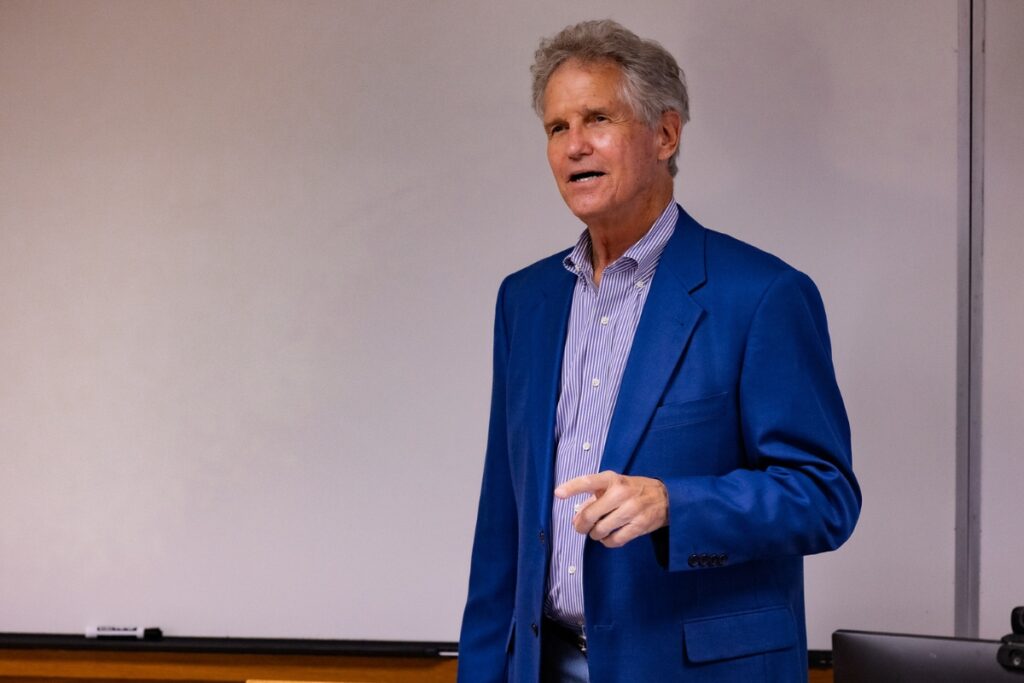
His practice evolved as it grew, and Downey has been practicing civil trial law in Texas for more than 50 years with offices in Austin and Houston. He has represented clients, as both an advocate and mediator/arbitrator, in matters of construction law, business law, product liability, personal injury, employment disputes, copyright and trademark, real property, oil and gas, and pharmaceutical litigation in federal and state courts.
Board certified in civil trial law, he is also a special judge who conducts trials under Chapter 151 of the Texas Civil Practice and Remedies Code.
Tapped by Gov. Bill Clements in 1988 to fill a vacancy, Downey became a state district court judge in Houston. He ran twice to keep the seat, winning both elections. “I left the bench and returned to practice because my daughters were becoming very expensive and college was on the horizon,” he said. One daughter is now a plastic surgeon in Houston; the other is a nurse practitioner in Austin.
As a judge, Downey encountered many young attorneys who were unprepared to be in the courtroom. That experience inspired him to become an adjunct professor. “I started teaching trial advocacy at South Texas before the school had developed an official advocacy program,” he said. “I wanted to help students know what to do and how to do it well.”
One aspect of being a judge while also being a teacher took Downey by surprise. “When former students came before my court as an advocate, I found it nerve-wracking. I was more nervous than they were because if they made a mistake, I couldn’t help them out. I just had to call balls and strikes while on the bench.”
Students enjoy taking Downey’s classes, which include analyzing clips from law-themed movies and taking field trips to the courthouse to watch trials and meet judges. “They tell me when they see these concepts in action at a trial, what they have been reading about finally makes sense,” he said.
An innovative educator, Downey created his own customized, downloadable course book for students covering core entertainment and sports law topics. He updates it frequently, as technology continues to evolve and impact the law.
Downey gives praise and credit to South Texas Law’s Louis Rodriguez, “a technology wizard’ in the Instructional IT Department. “I could not have done this without him,” Downey said. “He has guided me each semester and kept me operating in a world that no longer features blackboards and chalk as teaching tools.”
Reflecting on a legal career that has encompassed trial work, mediation, being a jurist, and being an adjunct professor, Downey was quick to say he has enjoyed teaching the most.
“Law professors really do shape the world, and most people don’t know this,” he said. “Unless they have a mentor available, law graduates who pass the bar are thrust upon the public to practice in any area of the law they please, without the training and guidance that comes with residency programs like those in the field of medicine. Law professors must teach them the law but also prepare them for the realities of the practice.”