

The JD degree program at South Texas College of Law Houston combines classroom instruction with practical skills development to train competent, confident lawyers who adhere to high ethical standards. Instructors use case studies, Socratic method, role-playing, writing, research, and analysis to provide students with a comprehensive legal education. In addition, skills institutes, mock trial, moot court, and legal clinic programs allow students to apply skills learned in the classroom to actual cases.
South Texas College of Law Houston offers the opportunity to enroll in the full-time program in the fall or spring. Applications should be received by May 8 (for fall entry) and December 1 (for spring entry). All applicants who apply by the Priority Deadline will automatically receive an application fee waiver.
The fall application opens at the beginning of December and the spring application opens at the beginning of August. While GPA and LSAT/GRE scores are important, we also assess each applicant’s life experience, work history, community service and graduate work.
Benefits of Attending STCL Houston
One of the benefits of attending South Texas College of Law Houston is the ability to begin your education when most convenient for you. Students can apply for admission in the spring, or in the fall. Both options provide the same outstanding education, exceptional course work, and offer the opportunity to graduate in three years.
Other benefits include:
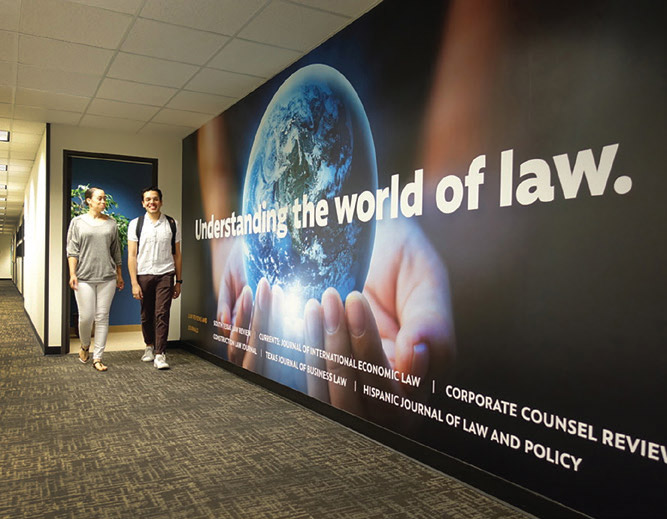
- Participate in student publications and journals, including the South Texas Law Review; CURRENTS: Journal of International Economic Law; Construction Law Journal; Hispanic Journal of Law and Policy; Texas Journal of Business Law; and the Corporate Counsel Review.
- Participate in on-campus interviews with law firms, nonprofits, and other hiring organizations.
- Earn credit in study-abroad programs during the summer session.
- Gain leadership experience in student organizations.
South Texas is one of a limited number of law schools in the nation who offers a spring or fall start, with all the benefits available to students year-round.
Full-Time Curriculum
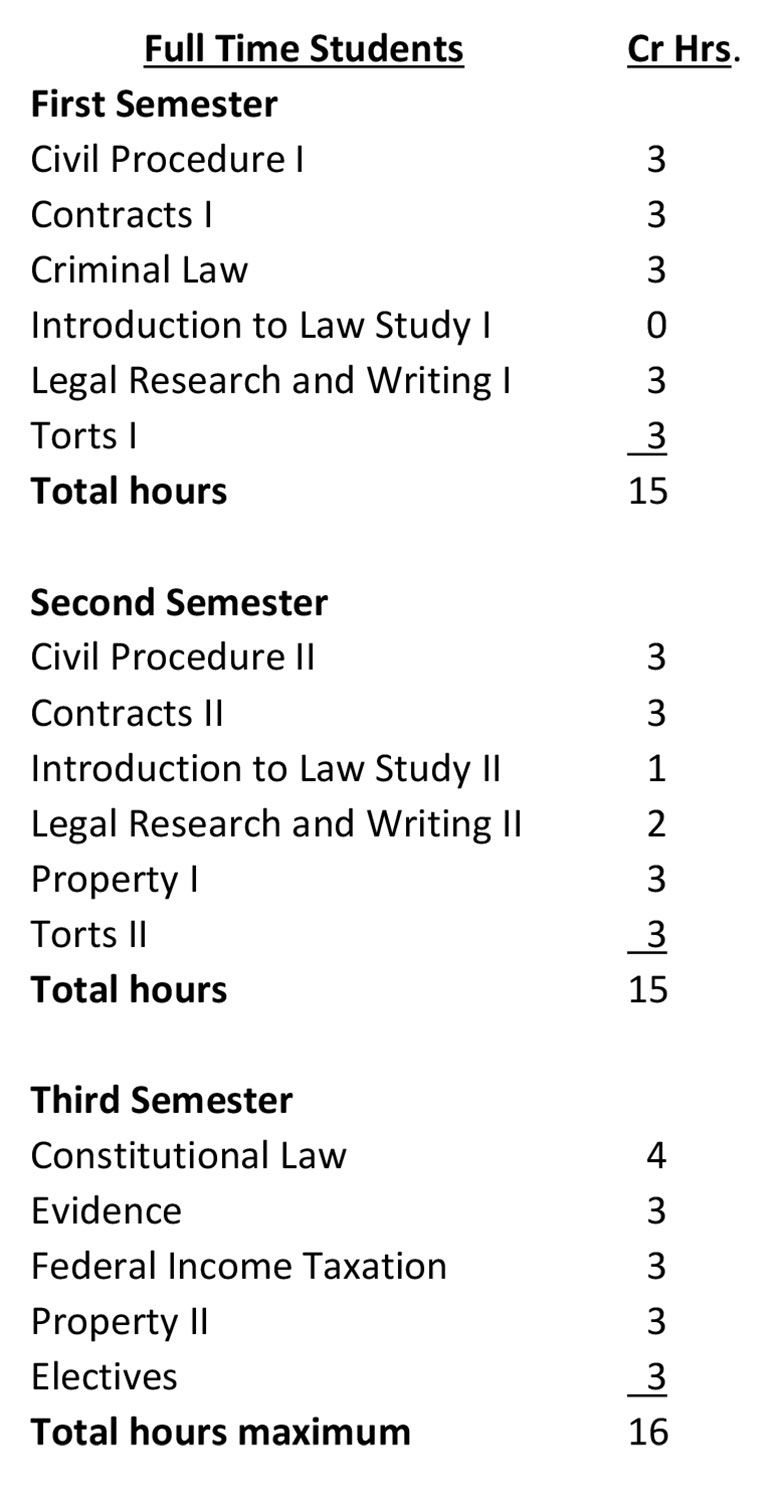
Curriculum plans for first-year law students in the full-time programs are shown below. Students can begin their coursework full-time in the fall, or full-time in the spring.
General Admissions Questions
In order to apply to our program you need a bachelor’s degree from an accredited university, a current LSAT or GRE score, an STCL Houston application, a personal statement, letters of recommendation, and a resume. All applicants must also register with CAS.
Additionally, once submitted, you must be able to provide a degree conferred transcript to the law school prior to the start of classes.
While we require an accredited bachelor’s degree it does not need to be in a specific area or focus.
Once admitted, a candidate must provide a degree conferred transcript prior to the first day of class if the degree was conferred after submitting the application to the law school. If official transcripts are not received by the first day of class for the fall semester, Student Services shall be notified and shall allow a reasonable time for the student to provide the official transcript, but no later than October 15th for students beginning in the Fall semester. For students beginning in the Spring semester, the official transcript must be received no later than the first day of class or by four weeks after the semester begins.
If the official transcript is not received by these deadlines, the student will be permitted to complete the current semester then in progress, but will not be permitted to register for courses in a subsequent semester absent a showing of extraordinary circumstances. This restriction may include canceling a student’s existing course registration for the subsequent semester, placing the student on a leave of absence, or administratively withdrawing the student following the completion of the current semester then in progress. A student will be eligible to return to the law school and resume their legal education once the official transcript is submitted provided the student meets all other requirements to continue in law school.
Yes, our spring class starts in early January. See the above question for deadline information.
We recommend taking the LSAT or GRE when you feel most prepared however by taking it on the earlier side of the application cycle it will allow you extra time should you want/need to retake the exam. Results are sent timely after your exam is taken.
Yes, as long as your application is submitted by the application deadline your application will be considered. Once we receive your score and your file is complete, we will place your application in review.
LSAT/GRE scores are valid for five years. Your most recent score must still be valid at the start of the semester for which you are applying.
We will consider your highest LSAT score as we review your application. However, all LSAT scores will be reported to us by CAS. We will consider all reportable GRE scores and will evaluate each section of the GRE independently. We are required to report to the ABA the highest score achieved.
Yes. All applicants are required to register with the CAS; foreign educated applicants will submit their foreign transcripts to the LSAC JD Credential Evaluation Service for evaluation. For information on CAS go to https://www.lsac.org.
If you would like to take advantage of the application fee waiver you should apply by February 9th (for Fall) and September 23rd (for Spring). We have a rolling admissions process, and we review applications as they are completed.
We admit students who are below the median and review all applications on a holistic basis. However if your scores or grades are on the lower side your personal statement, letters of recommendation, and resume will be very important.
We do not have a minimum LSAT/GRE score and all test scores will be considered. However, files are reviewed holistically.
We do not have a minimum GPA and like the LSAT/GRE, all files are reviewed holistically.
We will look at them however they are not weighed as heavily as undergraduate grades. Not all applicants earn graduate degrees, so it is better for us to use the undergraduate GPA. Also, we have no context for considering and comparing graduate grades.
Our admissions committee takes the personal statement very seriously. Since we do not offer Admissions interviews you should approach it as an opportunity to interview with the committee. You may write about your skills, strengths, advanced degrees, work experiences, personal struggles you have overcome, and professionally related extracurricular activities. Make sure that you do not restate your resume. In a separate statement of no more than 1 page, you may want to explain any mitigating circumstances in your record. Also, remember to proofread your information very carefully!
It should be 2-3 pages double-spaced.
No, we do not.
No. The Admissions Committee wants to have all kinds of people as part of its law school. As a non-traditional student, you can use your experience as a benefit in your application.
Yes, STCL Houston is accredited by both the ABA and the Supreme Court of Texas.
STCL Houston has been an ABA-accredited law school since 1959. The ABA is scheduled for its next routine accreditation site visit review of STCL Houston in Spring 2026. Upon successful completion of that review, STCL Houston’s ABA accreditation will be renewed for 10 years, with the next accreditation review not scheduled until 2036. ABA accreditation allows graduates to use their J.D. degree outside of Texas in any jurisdiction that recognizes ABA accredited law schools.
In the 2025-26 academic year, the Supreme Court of Texas issued Orders establishing the Court as the accrediting body for law schools offering JD degrees in Texas. The Court identified STCL Houston on the list of approved law schools, and adopted initial accreditation standards that STCL Houston meets and will continue to meet.
STCL Houston remains in good standing with both the State of Texas and the ABA, and the law school intends to maintain both accreditations in partnership with each accrediting body.
